
Due diligence
What to Ask a Carpet Cleaning Contractor
Carpet cleaning is bought on two promises that are almost never true: every mark will lift, and the floor will be dry in two hours. Three questions expose both before you pay, and they work on any contractor — including this one.
- Which method, really — extraction or encapsulation?
- What is the honest drying window?
- Which marks are soil, and which are permanent damage?
- Who carries the liability if the floor is ruined?
Operating since 2015
One documented cleaning standard, applied site by site across Sydney and regional NSW
- Police-checked cleanersVetted and inducted before they set foot on your site
- $20m public liabilityCertificates of currency issued before the first shift
- Rolling agreement, no lock-in termScope and price in writing within 24 hours
What should you ask a carpet cleaning contractor?
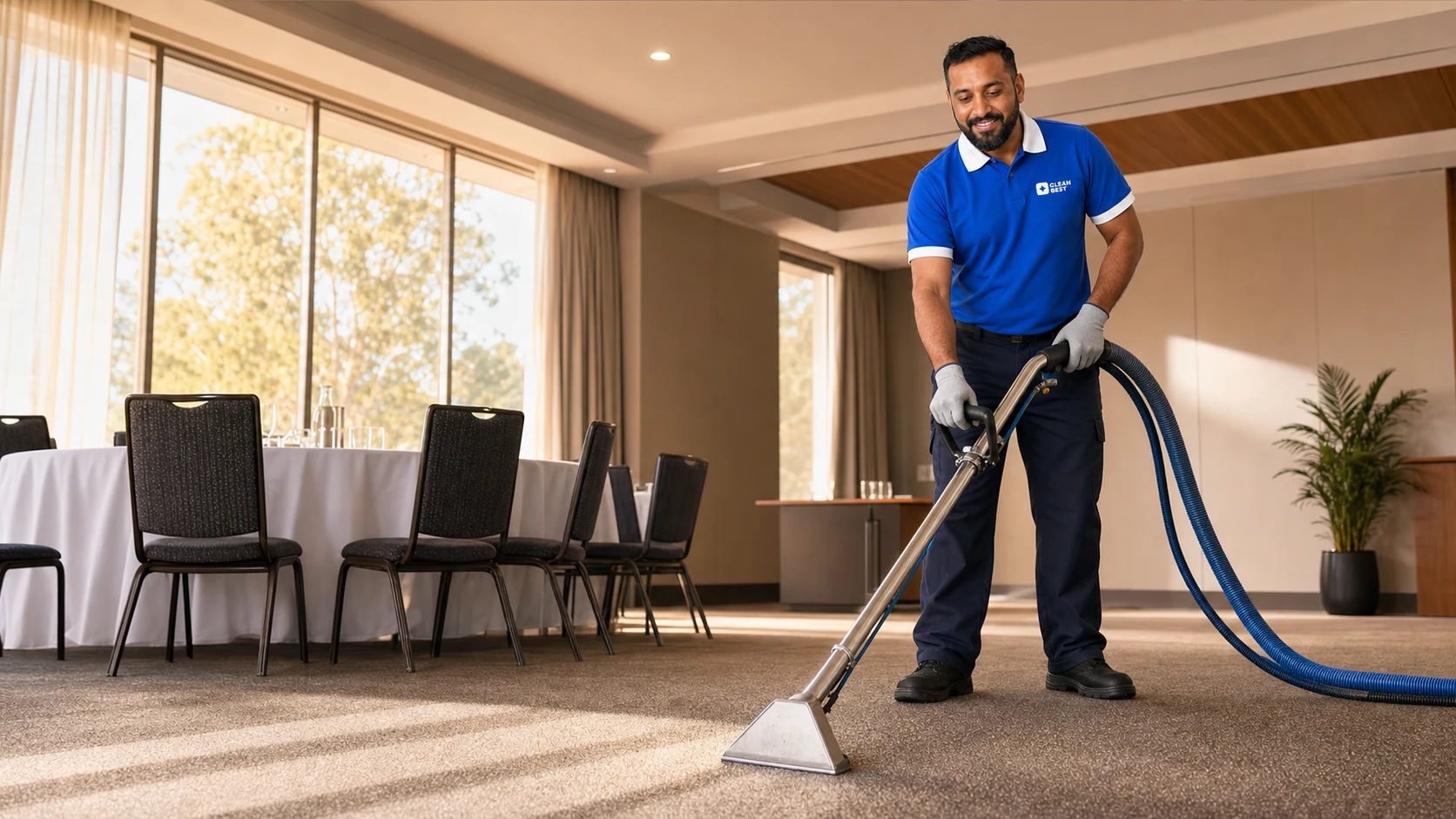
Ask which method is being used. Hot-water extraction injects hot solution into the pile and immediately vacuums it back out with the suspended soil. Encapsulation is a lighter, faster surface treatment, and it is sometimes sold under the language of extraction. Both have their place; being told one and given the other does not.
Ask for the drying window, and be suspicious of a short one. Properly extracted carpet in a ventilated space is usually walkable in four to six hours and dry overnight. A promise of two hours generally means less water was recovered than was applied, which leaves moisture in the underlay and is how a carpet acquires an odour it never previously had.
Ask which marks will not come out. Extraction removes soil, traffic-lane greying and most spills; it does not remove dye stains, bleaching, burns or long-set oil, which are permanent damage rather than soiling. Clean Best Australia tests an inconspicuous section, says which is which at inspection, and puts it in the written scope before any money changes hands.
- Operating since 2015Trading continuously since 2015
- Police-checked cleanersWorkplaces, clinics, campuses, buildings and homes
- $20m public liabilityPlus workers compensation for every person on the roster
- Every site audited monthlyFindings and corrective actions issued in writing
Method and scheduling
The questions, and the answers a real technician will give
Knowing what to ask a carpet cleaning contractor matters because carpet cleaning is bought badly more often than it is bought well, and not because of the machine. It is bought reactively, once somebody has complained, which means the grit has already been ground through the fibre for two years and no extraction will fully bring it back. And it is bought on optimistic promises — every mark will lift, the floor will dry in two hours — which are the two claims that make the whole trade look unserious.
A contractor worth appointing would rather be dull and correct. Every heading below is a question you can put to one.
What extraction can and cannot do
Hot-water extraction removes soil, traffic-lane greying, most spills and a surprising amount of odour. It does not remove dye stains, bleach damage, cigarette burns or oil that has been in the pile for a year. Those are damage, not dirt, and they will still be there when the machine is packed away. So we test an inconspicuous section, tell you which marks are which, and put it in the written scope — before you pay, which is the only moment the information is actually useful to you.
Drying time is a physics problem, not a sales opportunity
Water goes into the pile and water has to come out. A properly extracted office floor is walkable in four to six hours and dry overnight. If somebody quotes you two hours, they are either applying less solution than the carpet needs or leaving more moisture in the underlay than the underlay can shed — and the second one is how a carpet acquires a smell it never had before. We schedule around a real drying window, which usually means overnight or across a weekend.
Sequencing, so nobody loses a working day
A building does not have to close for its carpet. We sequence the work floor by floor, agreed before the first night, so no tenancy loses more than one evening and no team arrives to a damp office. On an eleven-floor building that is a three-week plan on paper rather than a fortnight of improvisation, and the plan exists before anyone turns up with a machine.
Interim maintenance, honestly labelled
Encapsulation has a genuine role between extractions on a heavily trafficked floor: it is quick, it dries fast, and it holds a busy entry zone together for a few months. What it is not is a substitute for extraction, and selling it as one is how a carpet ends up full of encapsulated soil that reappears the moment the polymer breaks down. Where interim maintenance fits, we will recommend it — and we will label it correctly.
Programmes rather than panics
For a portfolio, the useful thing is not the cleaning — it is the plan. We map the extraction programme across every site a year ahead, sequence it around your operational calendar, and give you a known annual figure instead of a series of urgent quotes. Common areas and corridors, which nobody owns personally and which are consequently always the last to be done, go into the same programme.
What it costs to find out
A supervisor inspects the carpet at no charge, tests a section, and tells you plainly what will lift and what will not. Within 24 hours you have a written scope, a sequence, a realistic drying window and a fixed price. If the honest answer is that a section of carpet is at the end of its life and should be replaced rather than cleaned again, we will say that too.
Call 02 5839 3012 and describe the marks.
Annual programmes
Carpet that is planned outlives carpet that is rescued
Grit is abrasive. Left in the pile, it cuts fibre every time somebody walks on it, and no extraction in the world puts fibre back. That is why a carpet cleaned reactively, once it looks bad, never quite recovers — the damage happened before anybody rang us.
A planned programme is not a sales device. It is the difference between carpet that reaches the end of its useful life and carpet that is replaced two years early, and across a portfolio that is a much bigger number than the cleaning ever was.
- Traffic lanes and entry zones on a shorter cycle than the full floor
- Full extraction planned annually rather than reactively
- Programme mapped across the portfolio a year ahead
- Replacement recommended honestly when cleaning has run out of road
The written specification
What a carpet extraction scope usually covers
The typical sequence for a Sydney commercial floor. Yours is written from the inspection and the fibre type.
- Inspect and test an inconspicuous area; identify soil versus permanent damage
- Move chairs, bins and light pedestals, and return them afterwards
- Dry-vacuum thoroughly to remove grit before any solution is applied
- Pre-treat traffic lanes, entry zones and identified spots
- Agitate the pile so the pre-treatment reaches the base of the fibre
- Hot-water extract with a pass rate that recovers what was applied
- Extra dry passes over traffic lanes and entries to shorten the drying window
- Groom the pile so the carpet dries evenly and lays in one direction
- Deploy air movers where ventilation is poor or the floor must be used sooner
- Spot-treat any mark that has wicked back once the floor is dry
- Clean entry matting, edges and skirting lines rather than stopping at the field
- Report any carpet at the end of its serviceable life rather than re-cleaning it
Dye stains, bleach damage, burns and long-set oil are permanent damage and are identified before the work is booked. Underlay replacement, carpet repair and re-stretching are quoted separately.
Commercials
How a carpet cleaning price is built
We price measured area, fibre type, soil load, furniture and access — and the drying window the space genuinely needs. The figure is fixed in writing before any machine arrives.
Single floor
One office floor, suite or tenancy needing traffic lanes and entry zones, or a full extraction.
- Hot-water extraction with a genuine drying window
- Traffic lanes, entry zones and spot treatment
- Honest assessment of what will and will not lift
- Scheduled overnight so the floor is usable in the morning
Fixed figure, issued in writing before anyone starts.
Whole building
Multi-floor tenancies and buildings sequencing extraction floor by floor without losing usable space.
- Floor-by-floor sequence agreed before the first night
- No tenancy loses more than a single night of carpet
- Interim encapsulation between extractions where it genuinely helps
- Reported alongside the recurring cleaning audit
Fixed figure, issued in writing before anyone starts.
Annual programme
Portfolios and agent-managed buildings planning extraction across every site as a known annual figure.
- Programme planned across the portfolio a year ahead
- Budget known in advance rather than arriving as a surprise
- Common areas, corridors and lift lobbies included
- One account manager, one report, one invoice
Fixed figure, issued in writing before anyone starts.
Site inspection at no charge, then a written scope and price inside 24 hours.
The process
How an extraction is scheduled
Four steps, and the honest conversation about what will not lift happens at step two, not after the invoice.
- 01
Show us the carpet
Call 02 5839 3012 with the floor area, the fibre if you know it, and which areas are the problem — traffic lanes, entry, under desks, or a specific spill.
- 02
Inspect and tell you the truth
We test an inconspicuous area, identify what is soil and what is damage, and tell you plainly which marks will not lift before you commit to anything.
- 03
Scope, sequence and price
Within 24 hours you get the written scope, the floor-by-floor sequence, the realistic drying window and a fixed price.
- 04
Extract and hand back dry
Work is done overnight or over a weekend with a genuine drying window, and the floor is handed back usable rather than technically finished.
FAQ
What buyers ask before booking a carpet extraction
What facilities managers, agents and building owners settle before the machine arrives.
How long does commercial carpet take to dry?
Properly extracted carpet in a ventilated office is usually walkable in four to six hours and fully dry overnight. Anyone promising two hours is either under-extracting or over-promising, and the consequence of both is the same: moisture left in the underlay, which is how a carpet develops a smell it never had before. We schedule the work to give the floor a genuine drying window rather than a convenient one.
Will carpet cleaning remove every mark?
No, and any contractor who says otherwise is setting up a difficult conversation for later. Traffic lanes, soil and most spills respond very well to hot-water extraction. Dye stains, bleach damage, burns and long-set oil are permanent damage rather than dirt, and no amount of extraction changes that. We tell you which is which at the inspection, before you pay, rather than after the machine is packed away.
How often should office carpet be extracted?
Traffic decides it. A busy open-plan floor with a street-level entry usually needs traffic lanes and entry zones every six months and a full extraction annually. A quieter suite can run on eighteen months. What matters more than the interval is that it is planned, because carpet that is only cleaned once somebody complains has already lost fibre to grit and will never fully come back.
Can you schedule extraction across a portfolio?
That is what this arm of Clean Best is for. Rather than reacting building by building, we plan the programme annually across every site you hold, sequencing floors so no tenancy loses more than a night, and reporting it against the same audit cycle as the recurring clean. It also means the budget is a known annual figure instead of a series of unwelcome surprises.
Do you move furniture?
We move what can be moved safely and put it back — chairs, bins, light pedestals. We do not lift desks with monitors and cabling still attached, and we do not empty a filing cabinet to get under it. Where a floor genuinely needs a full extraction, the most efficient approach is a clear-floor night agreed in advance, which we will schedule with you rather than discover on arrival.
What method do you use, and why not dry cleaning?
Hot-water extraction, because it is the method that actually removes soil rather than encapsulating it and leaving it in the pile to reappear. Encapsulation has its place as an interim maintenance step between extractions on a heavily trafficked floor, and we will recommend it where it fits. What we will not do is sell an interim method as a substitute for the real one.
Can you clean carpet in strata common areas?
Yes, and corridors are the classic case: they are cleaned last, if at all, because nobody owns them personally. Common area extraction is planned with the managing agent, scheduled overnight so residents are not walking damp carpet, and reported to the committee in the same document as the recurring clean, which usually settles the question of whether it was worth the money.
Is there odour treatment for damp or contaminated carpet?
There is treatment, and there is honesty about when treatment will not be enough. Odour from spills, damp and contamination can often be resolved with proper extraction and the correct treatment. Odour that has reached the underlay usually cannot, and replacing a section of underlay is a cheaper answer than repeatedly cleaning carpet that will smell again in a fortnight. We will tell you which situation you are in.
Keep reading
The rest of the due diligence
What a contractor should be able to evidence in each setting, and the documents to ask every one of them for.
Ask the three questions before you book the machine
Free inspection, an honest assessment of what will lift and what will not, and a fixed written price within 24 hours. Call 02 5839 3012.