
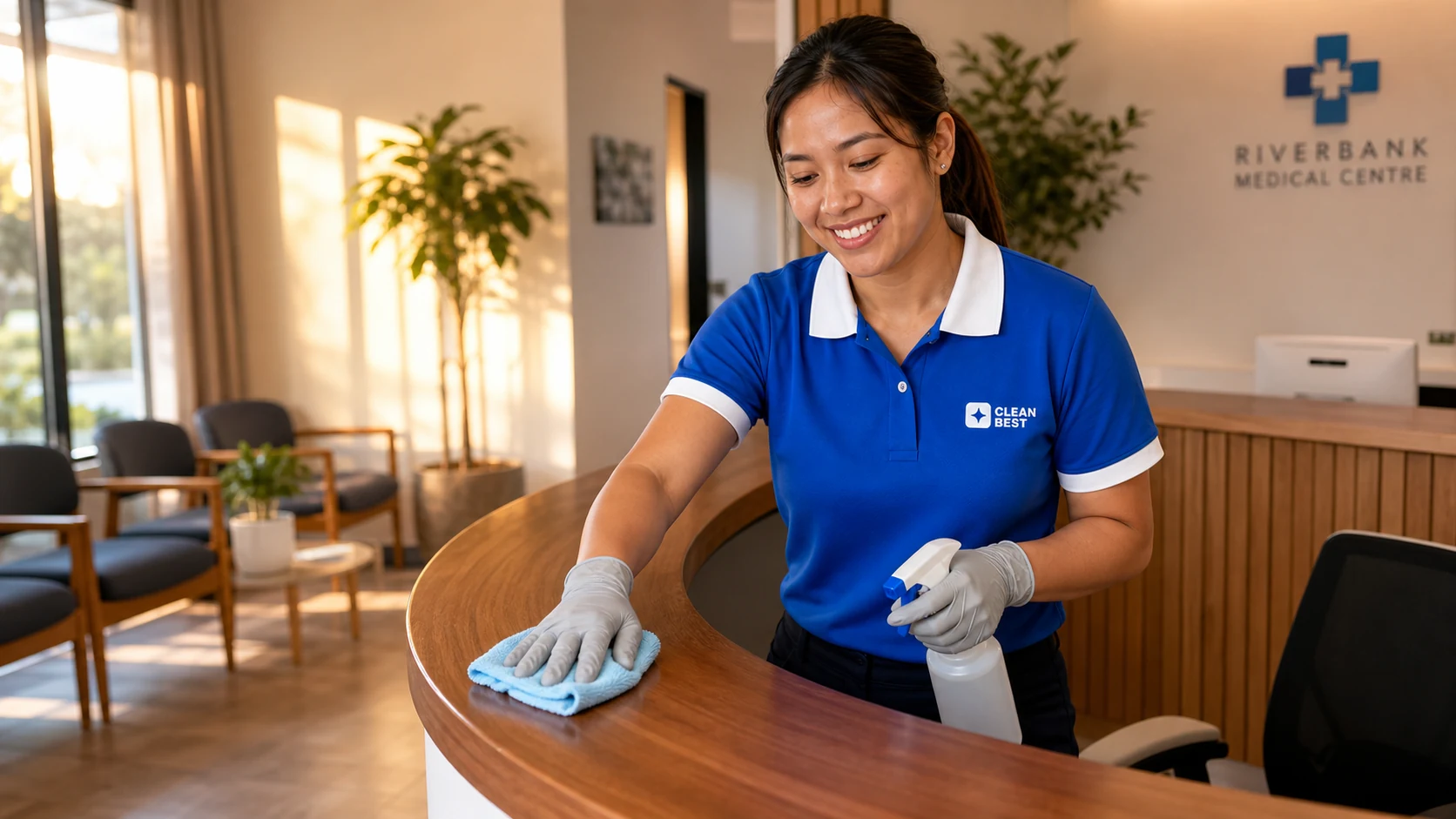
Clinical standards
Medical Centre Cleaning: Infection Control Standards to Demand
A practice does not fail an accreditation review because the floors were dirty. It struggles because nobody can demonstrate what was cleaned, with what, for how long, and by a person whose background was checked. These are the standards to hold a clinical cleaner to.
- Contact time: where clinical cleaning quietly fails
- Colour-coded separation, enforced rather than encouraged
- The chemical register and safety data sheets to demand
- Task records that exist before the surveyor asks
Operating since 2015
One documented cleaning standard, applied site by site across Sydney and regional NSW
- Police-checked cleanersVetted and inducted before they set foot on your site
- $20m public liabilityCertificates of currency issued before the first shift
- Rolling agreement, no lock-in termScope and price in writing within 24 hours
What infection control should a medical centre cleaner evidence?
A cleaning contractor working in a healthcare setting should be able to evidence four things. First, that disinfectants appropriate to a clinical setting are used and left on the surface for the contact time the manufacturer specifies — sprayed and immediately wiped, a disinfectant is an expensive way of moving contamination around a bench. Second, that cleaning is performed before disinfection, because a disinfectant applied over soil does very little.
Third, that equipment is colour-coded and physically separated, so cloths and mop heads never travel between washrooms, clinical areas and general areas. Fourth, that the work is recorded: a written specification, a chemical register with a current safety data sheet for every product, and a task record confirming the work was performed.
Sharps and contaminated clinical waste remain the practice’s responsibility under its own waste contract, and no cleaning contractor should suggest otherwise. Clean Best Australia writes a specification per clinic and holds the register and task records from the first shift. NSW Health publishes guidance on cleaning and infection prevention in healthcare settings and is the right reference before a scope is written.
- Operating since 2015Trading continuously since 2015
- Police-checked cleanersWorkplaces, clinics, campuses, buildings and homes
- $20m public liabilityPlus workers compensation for every person on the roster
- Every site audited monthlyFindings and corrective actions issued in writing
Method and evidence
The standards to hold a clinical cleaner to, and how to check them
Medical centre cleaning infection control is usually judged by the buyer on how the waiting room looks. That is the wrong test, and every practice manager who has been through an accreditation cycle knows it. The waiting room is the easiest room in the building. The questions that actually get asked are about the treatment bench, the contact time on the disinfectant, whether the same cloth touched the toilet and the trolley, and whether anyone wrote any of it down.
Every heading below is a question you can put to any contractor bidding for your practice, including us. In a clinical setting the written standard is not administrative overhead. It is the product.
Contact time is where clinical cleaning quietly fails
A hospital-grade disinfectant is only a disinfectant if it is left on the surface for the time the manufacturer specifies. Sprayed and immediately wiped, it is an expensive way of moving contamination around a bench. Our cleaners are trained on the contact time for each product on the site register and on the order of work — clean before you disinfect, because a disinfectant applied over soil does very little. It is unglamorous, it is the whole job, and it is the first thing we audit.
Colour-coding, enforced rather than encouraged
Equipment is separated by area and the separation is physical, not notional: the cloths and mop heads used in washrooms never enter a clinical space, and clinical equipment never travels to a general area. Practices that have watched a previous contractor carry one bucket around the building know exactly why this matters. It is also the thing an infection control nurse will look for in the first five minutes of watching a new cleaner, so we would rather she watch.
Where our responsibility stops
Sharps and contaminated clinical waste stay with the practice under its own waste contract. Our cleaners are instructed never to handle a sharps container or a clinical waste bin beyond replacing an outer liner where your own procedure explicitly permits it. Drawing that line in the specification is not us avoiding work — it is the only way to make sure nobody improvises at eight in the evening when the bin is full and the cleaner is trying to be helpful.
The record is the deliverable
Each clinic has a written specification, a chemical register with the safety data sheet for every product in use, and a task record confirming the work was performed. Add the insurance certificates and the police check register and that is, in practice, the entire cleaning section of an accreditation submission. It exists from the first shift. Practices come to us mid-cycle, three weeks out from a surveyor visit, precisely because the previous contractor could not produce any of it.
Networks of clinics, one standard
Practice groups running several sites almost always inherit a different cleaner at each one, which means a different standard, a different chemical register and no way to tell which clinic is exposed. One agreement across the network gives each clinic its own specification — a dental practice with a sterilisation room is not a GP clinic — while sharing the vetting, the insurance, the audit cycle, the account manager and the invoice. The reporting is what most group managers actually wanted; the cleaning improvement is a bonus.
What it costs to find out
An after-hours inspection at no charge, walked with your practice manager so the restricted rooms and the equipment separation are agreed rather than assumed. Within 24 hours you have the specification, the chemical register and a fixed price. The agreement is rolling with thirty days notice, however many clinics it covers.
Call 02 5839 3012 and tell us when the last patient leaves.
Accreditation
The paperwork exists before the surveyor asks for it
Practices do not fail an accreditation review because the floors were dirty. They struggle because nobody can demonstrate what was cleaned, with what, how often, and by a person whose background was checked. The cleaning was probably fine. The evidence was never created.
Every clinic on our register holds a written specification, a chemical register with safety data sheets, a task record, insurance certificates and the police check register for the assigned cleaner. It is prepared at mobilisation, kept current, and handed over the day it is asked for rather than reconstructed under pressure.
- Written specification per clinic, not per contract
- Chemical register and safety data sheets kept current
- Task records demonstrating the work was performed
- Police check register and WWCC where the setting requires it

The written specification
What a clinical specification usually covers
A typical per-visit scope for a Sydney medical centre. Yours is written from the inspection and your infection control requirements.
- Disinfect treatment and consulting room benches, trolleys and equipment surfaces
- Clean and disinfect examination couches, chairs and height-adjustable bases
- Disinfect high-touch points: door handles, light switches, taps, keyboards and rails
- Clean and restock hand hygiene stations and glove and mask dispensers
- Sanitise washrooms and patient toilets; restock paper, soap and hand towel
- Clean and present reception, waiting room seating, children's areas and magazines
- Vacuum and mop all floors using colour-separated equipment per area
- Clean sterilisation and utility rooms to the practice's stated procedure
- Empty general and recyclable waste and replace liners
- Clean internal glass, reception screens, mirrors and entry doors
- Wipe skirtings, sills, blinds and vents on a documented periodic rotation
- Complete the task record and note anything requiring the practice's attention
Sharps and contaminated clinical waste remain the practice's responsibility under its own waste contract. Carpet extraction, hard-floor treatment and high-level cleaning run as separate periodic programmes.
Commercials
How a medical cleaning price is built
We price the number of consulting and treatment rooms, the surfaces, the infection control requirements and the frequency the practice needs — never a per-square-metre rate, which ignores the entire point of clinical cleaning.
Single practice
One clinic — a GP practice, dental surgery, allied health suite or specialist room — with its own reception and amenities.
- Specification written around your consulting and treatment rooms
- Colour-coded equipment separation as standard
- Chemical register matched to your accreditation requirements
- The same police-checked cleaner each visit
Fixed figure, issued in writing before anyone starts.
Multi-room centre
Larger medical centres with many consulting rooms, procedure or treatment rooms, pathology and a busy waiting area.
- Nightly service with treatment rooms fully reset
- Touchpoint disinfection recorded against the task record
- Waiting room, reception and washroom presentation each visit
- Monthly supervisor audit against the written specification
Fixed figure, issued in writing before anyone starts.
Clinic network
Practice groups running several clinics who need one standard, one contact and records that survive an accreditation review.
- A specification per clinic, one agreement across the network
- Consolidated compliance pack held for accreditation
- One account manager who has walked every practice
- One consolidated invoice for the whole network
Fixed figure, issued in writing before anyone starts.
Site inspection at no charge, then a written scope and price inside 24 hours.
The process
How a practice changes cleaners
Four steps, and we will not skip the induction to hit a date — an uninducted cleaner in a treatment room is a worse risk than another week with the incumbent.
- 01
Tell us about the practice
Call 02 5839 3012 with the number of consulting and treatment rooms, your closing time, and any infection control requirement your accreditation body imposes.
- 02
After-hours inspection
A supervisor walks the clinic after the last patient, identifies the surfaces, the restricted rooms and the equipment separation the site needs.
- 03
Specification, register and price
Within 24 hours you receive the written scope, the chemical register with safety data sheets, and a fixed price for the practice.
- 04
Induct, start, audit
The cleaner is inducted on your infection control expectations, starts on the agreed date, and a supervisor audits the clinic monthly.
FAQ
What practices ask before changing cleaning contractor
What practice managers, clinical nurse managers and group operations leads settle before they sign.
What should infection control cleaning actually look like in practice?
Three things distinguish it from ordinary commercial cleaning: the products, the sequence and the record. Disinfectants must be appropriate to a clinical setting and left for the contact time the manufacturer specifies rather than wiped straight off. Equipment must be colour-coded and separated so a cloth never travels from a toilet to a treatment bench. And the work must be recorded, because in an accreditation review the question is not whether the room was cleaned but whether you can demonstrate that it was.
Do you clean during or after consulting hours?
Almost always after the last patient leaves, so treatment rooms can be fully reset without a clinician working around a cleaner. Practices running long or weekend hours sometimes add a mid-day service for waiting rooms, washrooms and touchpoints. That work is scoped differently — quiet equipment, no wet floors across patient paths, no strong odours near consulting rooms — rather than an evening scope performed in daylight.
How do you handle clinical waste?
We do not handle it, and no cleaning contractor should tell you otherwise. Sharps and contaminated clinical waste are the practice's responsibility under its own waste contract, and our cleaners are instructed never to touch a sharps container or a clinical waste bin beyond replacing the outer bin liner where the practice's procedure allows it. General and recyclable waste we remove. The line is drawn in the specification so nobody has to improvise at 8pm.
What disinfectant products are used on treatment room surfaces, and how is that documented?
Hospital-grade disinfectants appropriate to the surface, applied at the contact time the manufacturer specifies rather than sprayed and immediately wiped, which is where most clinical cleaning quietly fails. Every product is listed on the site chemical register with its safety data sheet attached, and if your practice or your accreditation body requires a particular product, the register is written to match at the inspection rather than argued about later.
Do you provide records for accreditation?
Yes. Each site has a written cleaning specification listing what is done per visit, weekly and periodically, plus a task record confirming the work was performed. Together with the chemical register, safety data sheets, insurance certificates and police check records, that is what a practice needs when an accreditation surveyor asks how cleaning is managed. It is prepared as a matter of course rather than assembled in the fortnight before a visit.
Can you clean a network of clinics under one agreement?
Yes, and it is the most common reason practices come to this arm of Clean Best. Each clinic gets its own specification, because a dental practice with a sterilisation room and a bulk-billing GP clinic with eight consulting rooms are not the same job. What is shared is the vetting, the insurance, the audit cycle, the account manager and one invoice — which is normally the point at which a practice manager gets a day back at month end.
What vetting should a cleaner working in a clinic have?
Ask for the police check register naming the individuals who will attend, not a blanket claim on a website. Where the practice is paediatric or an allied health service treating children, ask for Working with Children Check numbers and expiry dates so you can verify them. Ask, too, whether the cleaner has been inducted on your own infection control expectations, on which rooms they may not enter, and on the colour-coding system — and whether that induction was recorded against the site.
How quickly can a practice change cleaners?
A single clinic is usually inspected within 48 hours and cleaned inside the week. Practices in the middle of an accreditation cycle sometimes want it faster, and we can usually accommodate that, but not at the cost of skipping the induction — an uninducted cleaner in a treatment room is a bigger risk to the practice than one more week with the incumbent.
Keep reading
The rest of the due diligence
What a contractor should be able to evidence in each setting, and the documents to ask every one of them for.
Ask for the chemical register before you ask for a price
Free after-hours inspection, then a written specification, the chemical register and a fixed price within 24 hours. Call 02 5839 3012.